The America is one of the world’s leading producers of onions and they are commonly used in home cooking, in the food service industry, in food processing, and in the retail market. The steady level of consumer demand is the reason why onion farming and the handling of onions after harvesting are important parts of the U.S. agricultural supply chain.
The National Agricultural Statistics Service (NASS) of the U.S. Department of Agriculture (USDA) reports that U.S. onion production in 2024 amounted to about 77.1 million hundredweight (cwt), which is equivalent to around 3.5 million metric tons. The total area under onion cultivation was approximately 136,500 acres, of which 134,900 acres were harvested, the crop realizing a value of about $2 billion.
These figures show just how large the U.S. onion industry is, this size in turn leading to a real need for the equipment used in post-harvest operations such as sorting, cleaning, peeling, and packaging.
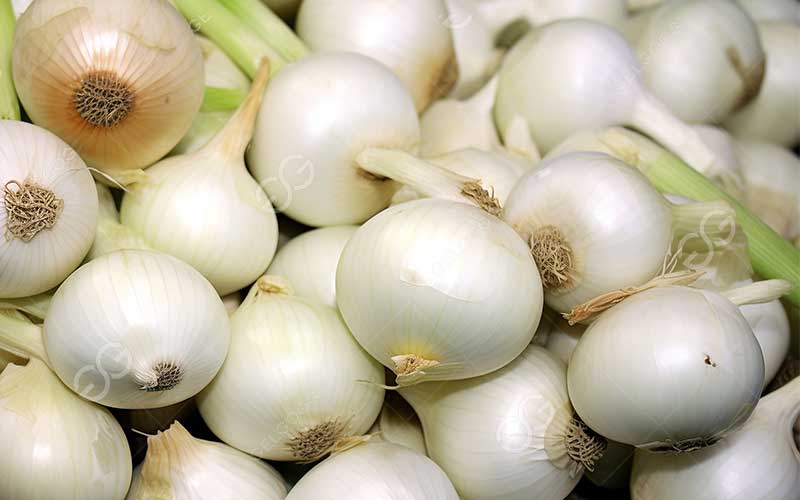
Following harvest, onions generally have a dry outer skin, usually with some soil or other impurities on it. Before they can move on to particular sales or processing stages, they have to be cleaned in accordance with the requirements of the product. Peeling is a vital part of this preliminary post-harvest processing. Onion peeling machines allow farms to improve their processing efficiency and thus decrease the amount of manual, one-by-one peeling that is required.
It should be noted that the type of onion, its size, how mature it is, and the dryness of its outer skin all have an effect on the peeling process; consequently, when choosing equipment it is necessary to make sure that the machine is appropriate to the particular features of the raw material and to the processing volume that the farm anticipates. In the case of onions which are to be stored, the drying, storage, and peeling should all be carefully coordinated in order to avoid any unnecessary loss in quality.
A customer from the United States contacted us to say that he needed to carry out some initial peeling of his onions after harvesting before putting them on the market. Before deciding to place an order, he looked at a number of different equipment suppliers in order to find one that would be most appropriate for the conditions existing on his farm. After making a careful comparison and having a detailed discussion, he finally went with our onion peeling machine.
For farm owners, selecting equipment typically requires careful consideration of the following factors:
– Regarding equipment suitability: the machinery has to be compatible with the particular kinds of onions, their sizes and the condition of their skin as grown on the farm, and must also satisfy the requirements for the preliminary post-harvest processing.
– In terms of processing efficiency, the equipment should match the farm’s processing rate since onion harvesting is a seasonal activity in order to avoid having a backlog after harvesting.
– In terms of product loss, the peeling process should be designed in such a way as to cause as little damage as possible to the edible parts of the onions, in order to prevent an unnecessary loss of raw material.If you want to find out which model is most appropriate for your requirements, please get in touch with us.