Onions are a vegetable with a very wide range of uses. From restaurant kitchens to condiment factories, and from frozen foods to meat processing, onions are frequently used as an important ingredient.
For food processing companies, onions are more than just a raw ingredient. Once diced to a standardized size, onions can be more easily incorporated into subsequent stages such as stir-frying, deep-frying, seasoning, mixing, freezing, or packaging. As a result, onion dicing machines have gradually become essential equipment in many vegetable processing and food production lines.
Compared to manual dicing, industrial dicing equipment is better suited for processing continuous, high-volume batches of onions and can adjust the dice size according to product requirements.
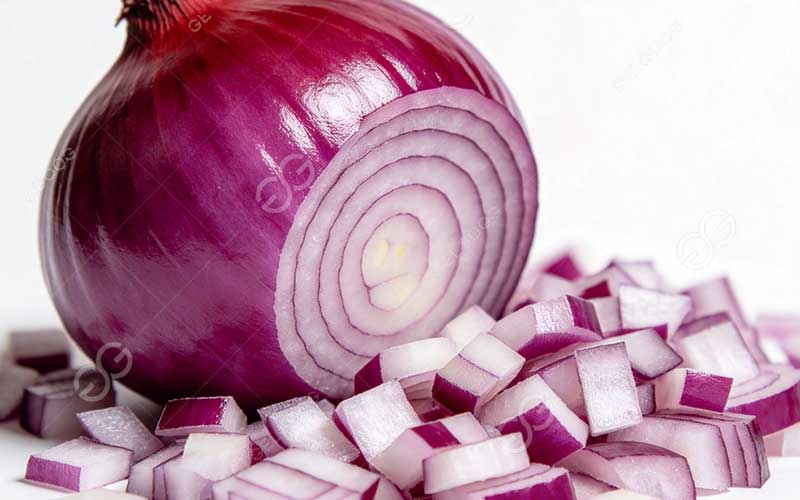
What Is Onion Dicing Machine Application?
Diced onions may seem simple, but they are actually included in the recipes of a wide variety of food products. Different processing companies vary in the size, shape, and preparation methods they use for diced onions.
1. Hamburgers, sandwiches, and fast food
In fast food items such as hamburgers, hot dogs, and sandwiches, onions are typically used as a vegetable topping.
2. Pizza and Baked Goods
Diced onions are also common ingredients in pizza, savory breads, pies, and other baked goods.
3. Sauces and Seasoning Blends
Ketchup, hot sauce, hamburger sauce, barbecue sauce, and other seasoning blends also use onion pieces of various sizes.
4. Meat Products
Onions are used as a flavoring ingredient in sausages, hamburger patties, and some cured meat products.
Why Do Food Processing Plants Need to Use Onion Dicing Machines?
When the volume of onions processed increases from tens of kilograms to hundreds of kilograms or even more, manual dicing gradually reveals issues related to efficiency, consistency, and production management.
1. Consistent Product Specifications
Onion dicing machines can be configured to meet specific cutting specifications based on product requirements. For food processing plants, consistent onion dice size not only affects product appearance but also impacts subsequent cooking, frying, freezing, and mixing results.
2. Improving Continuous Processing Capacity
Manual dicing is a typically labor-intensive process, whereas industrial equipment can be integrated with upstream washing and peeling equipment as well as downstream conveying, mixing, quick-freezing, and packaging equipment. For food companies requiring long-term production, mechanized processing integrates more easily into the overall production line.
3. Reducing Manual Labor
Onions release irritating volatile compounds during the cutting process, and prolonged manual handling can affect workers’ comfort.
Using automated or semi-automated dicing equipment reduces the time employees spend directly involved in cutting, allowing them to focus more on loading, quality inspection, and production management.
4. Easier Control of Production Quality
With fixed cutting parameters and standardized equipment, companies can more easily establish their own raw material processing standards, such as:
- Diced onion size
- Hourly processing capacity
- Raw material waste control
- Product integrity after dicing
- Ingredient ratios for subsequent products
These metrics can be further integrated into the company’s production and quality management systems.
In Which Industries Can Onion Dicers Be Used?
- Vegetable processing industry
- Frozen food industry
- Prepared meals and central kitchens
- Seasoning industry
- Foodservice and fast-food supply chains
How to Choose the Right Industrial Onion Dicer?
To choose the right onion dicer, consider the following factors:
- First, target production capacity.
- Second, onion variety and raw material condition.
- Third, target dice size.Fourth, whether a complete production line is required.